- Alice in Wonderland is Tim Burton having his cake and eating it (The Guardian)
- Art Center College of Design in Pasadena announced that Robert C. Davidson Jr. has been elected chairman of its board of trustees -- the first African American to take that top leadership role at the institution.(Los Angeles Times)
- Art Review: 'Changing the Focus: Latin American Photography 1990-2005' at the Museum of Latin American Art (Los Angeles Times)
- Barnes Countdown: "Art of the Steal" Premiere; "Final Year" in Merion (CultureGrrl)
- Best in Show Hitler vs. Eli Broad: A Comedy (T Magazine)
- Chanel Treasures on Sale at Paris' Drouot Richelieu Auction House (Artdaily.org)
- Henry Moore: An Easy-To-Love Giant of British Art (WSJ)
- The Koons Collection (New York Times)
- Moore’s ‘Visceral’ Blobs Plop Down at Tate Britain: Review (Bloomberg)
- Obama confers twelve National Medal of Arts and eight National Humanities Medal. Of special note are: Maya Lin and Frank Stella and a shout out to the fab Mz Rita Moreno! (Los Angeles Times)
- Rah-rah-ah-ah-ah! Lady Gaga at MOCA (T Magazine)
- Renowned Indian artist MF Husain, under attack from hardline Hindus for his paintings of nude Hindu goddesses, has been offered Qatari nationality (BBC)
- Sex in an art gallery? Klimt would approve (The Guardian)
- VIVA Glam: Painted Ladies Lady Gaga and Cyndi Lauper (T Magazine)
- Whitney Biennial: At a Biennial on a Budget, Tweaking and Provoking (New York Times)
- Whitney Biennial Mishmash Serves Up Michael Jackson, Macrame (Bloomberg)
Thursday, February 25, 2010
Daily Brend Feed

Wednesday, February 24, 2010
Daily Brend Feed
ArtDaily.org: After London and Before Madrid, the Grand Palais in Paris Welcomes Turner and the Masters
ArtForum: Evicted Artists Protest in Beijing
The Art Newspaper: Shock appointment of anti-modernist to Venice Biennale
CultureGrrl: Whit-Split: Biennial Less Than the Sum of Its Part
CultureGrrl: Whitney Biennial (and Kentridge at MoMA): Let the Debate Begin
Fine Arts LA: Let Those Artists Speak
The Guardian (UK): Ambassador, you are spoiling our view
The Independent: For its new English home, America builds a castle
LAT: Getty, Disney partner on study of animation cel artwork
NPR: 'Equation,' 'Gingerly' And Other Linguistic Pet Peeves
The Washington Post: National Museum of Women in the Arts to turn D.C. corridor into sculpture alley
WSJ: Wangechi Mutu is Deutsche Bank's Artist of the Year 2010
ArtForum: Evicted Artists Protest in Beijing
The Art Newspaper: Shock appointment of anti-modernist to Venice Biennale
CultureGrrl: Whit-Split: Biennial Less Than the Sum of Its Part
CultureGrrl: Whitney Biennial (and Kentridge at MoMA): Let the Debate Begin
Fine Arts LA: Let Those Artists Speak
The Guardian (UK): Ambassador, you are spoiling our view
The Independent: For its new English home, America builds a castle
LAT: Getty, Disney partner on study of animation cel artwork
NPR: 'Equation,' 'Gingerly' And Other Linguistic Pet Peeves
The Washington Post: National Museum of Women in the Arts to turn D.C. corridor into sculpture alley
WSJ: Wangechi Mutu is Deutsche Bank's Artist of the Year 2010
Giorgio Armani does Gaga

 Vogue UK is reporting that Giorgio Armani has confirmed that he will desing outfits for Lady Gaga's revamped Monster Tour. This sketch (above) of a sparkly structured body suit with enhanced curved shoulders is only one of the many looks he will be creating. Lady Gaga's collaborations do not cease to surprise! Armany states "In addition to her formidable songwriting skills, she is a modern fashion phenomenon." We are so jealous right now, it must be quite amazing to be Gaga!
Image captions: (Above) Armani sketchs for Lady Gaga's coustumes for the Monster Tour
 (Left) Lady Gaga pictured at the 2010 Grammys in Giorgio Armani Privé.
Happy birthday Winslow Homer! (b. Boston, MA, February 24, 1836 – d. Prout's Neck, ME, September 29, 1910)
 Winslow Homer, Breezing Up (A Fair Wind), 1873-1876, oil on canvas, 24 3/16 x 38 3/16 in
National Gallery of Art (Washington DC) Collection
Tuesday, February 23, 2010
Daily Brend Feed
Updated!
ArtsJournal: Biennale to Biennial: Whitney Guest Curator Bonami Organized Venice Display
Critics Loved to Hate
Grazia: Alexander McQueen’s Last Interview
The Guardian (UK): Arts internships: chance of a lifetime or cut-price labour?
The Guardian: Dark matter
The Guardian: Strike a pose
LAT: Eli Broad, Ovation TV's Charles Segars lend a hand to LAUSD arts education campaign
LAT: Long Beach City Council will consider laws to help the local arts scene
LAWeekly: Purpose Restoration's Graffiti Art Influenced, Eco-Friendly Furniture
NYT: Women’s Work
NYT: Abbey Road Studio Is Given Protected Status
NYT: Evicted Artists Protest After Attack in Beijing
Style.com: An Amy Winehouse Explosion You’ll Actually Want To See
Village Voice: Oh, Yoko Ono
Village Voice: Dancing Barefoot: Patti Smith's Just Kids
Washington Post: Art Man cometh
WSJ: Wangechi Mutu is Deutsche Bank’s Artist of the Year 2010
ArtsJournal: Biennale to Biennial: Whitney Guest Curator Bonami Organized Venice Display
Critics Loved to Hate
Grazia: Alexander McQueen’s Last Interview
The Guardian (UK): Arts internships: chance of a lifetime or cut-price labour?
The Guardian: Dark matter
The Guardian: Strike a pose
LAT: Eli Broad, Ovation TV's Charles Segars lend a hand to LAUSD arts education campaign
LAT: Long Beach City Council will consider laws to help the local arts scene
LAWeekly: Purpose Restoration's Graffiti Art Influenced, Eco-Friendly Furniture
NYT: Women’s Work
NYT: Abbey Road Studio Is Given Protected Status
NYT: Evicted Artists Protest After Attack in Beijing
Style.com: An Amy Winehouse Explosion You’ll Actually Want To See
Village Voice: Oh, Yoko Ono
Village Voice: Dancing Barefoot: Patti Smith's Just Kids
Washington Post: Art Man cometh
WSJ: Wangechi Mutu is Deutsche Bank’s Artist of the Year 2010
Sunday, February 21, 2010
Weekend's Brend Articles
Bloomberg: McQueen’s Last Show, Sporty BMW Vie for Design Award
The Independent (UK): The annotated Lady Gaga: A field guide to the wildest wardrobe in pop
The Independent: A-Z of Alice in Wonderland
LAT: Art is the message on these billboards
LAT: Camilo Ontiveros wins ARCOmadrid prize
NYT: Part Traditionalist, Part Naturalist, Part Dissident
NYT: Designed to Help Uplift the Poor
NPR: Celebrating Caravaggio: First Of The Bad-Boy Artists
WSJ: Heard on the Runway
WSJ: The Whitney Biennial Lightens Up
The Independent (UK): The annotated Lady Gaga: A field guide to the wildest wardrobe in pop
The Independent: A-Z of Alice in Wonderland
LAT: Art is the message on these billboards
LAT: Camilo Ontiveros wins ARCOmadrid prize
NYT: Part Traditionalist, Part Naturalist, Part Dissident
NYT: Designed to Help Uplift the Poor
NPR: Celebrating Caravaggio: First Of The Bad-Boy Artists
WSJ: Heard on the Runway
WSJ: The Whitney Biennial Lightens Up
Happy birthday Albrecht Dürer! (b. Nuremberg, Holy Roman Empire, 21 May 1471 – d. Nuremberg, Holy Roman Empire, 6 April 1528)
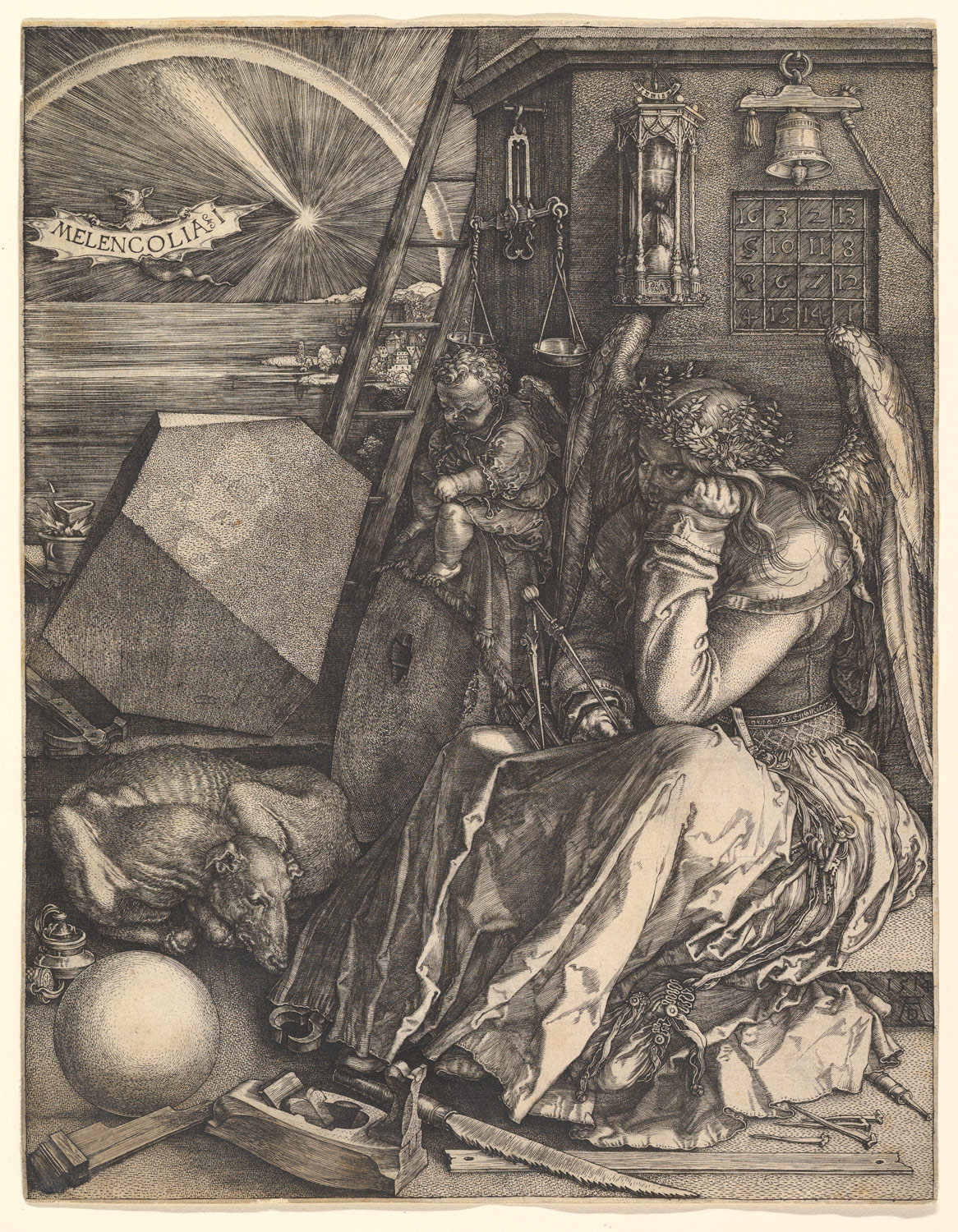 Albrecht Dürer, Melencolia I, 1514, Engraving, 9 1/2 x 7 3/8 in.
Subscribe to:
Posts (Atom)